
Drops, wipes and supplements for optimal eye comfort.
There are some things glasses can't fix. A new prescription sharpens what a resident sees - it won't settle eyes that sting all afternoon, or lids that are sore and crusted every morning. Those things have their own answers, and they are simpler than most people expect. Our optometrist spots which one fits while examining the eyes, and everything is delivered to the home.
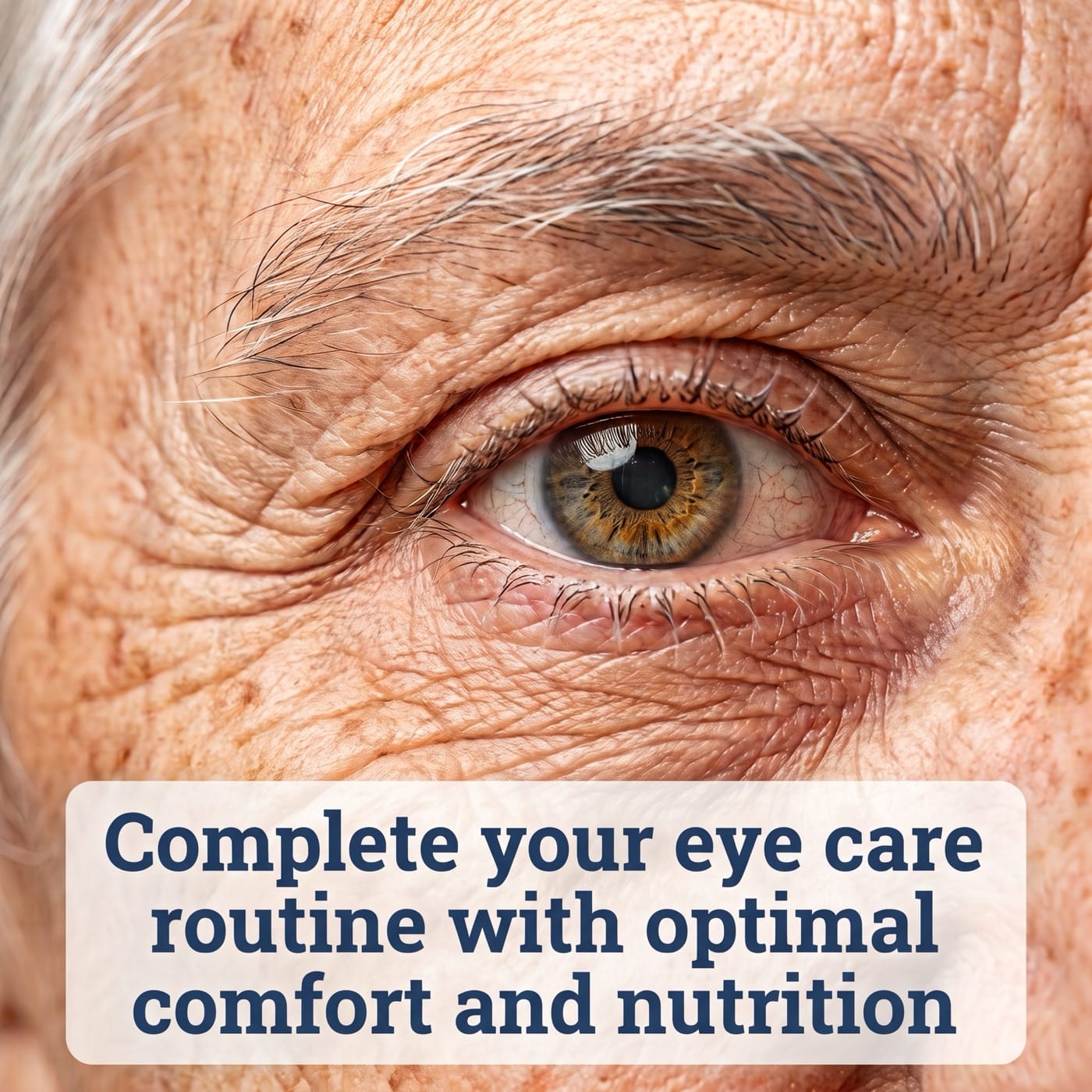
Who is this page for? Care teams, families and residents themselves. Dry, sore eyes are one of the most common - and most overlooked - discomforts in later life, and in a care setting they often go unreported entirely, because the person who has them can no longer easily say so.
When someone can't tell you their eyes hurt.
A resident living with dementia, recovering from a stroke, or simply of a generation that doesn't like to make a fuss may never once mention that their eyes are sore. The discomfort doesn't disappear. It just shows up as behaviour instead - and behaviour gets read as confusion, low mood, or “having a bad day”.
Care staff and visiting family are the ones who notice these things, long before anyone thinks to call an optician. If several of the signs opposite sound familiar for someone you look after, it is worth mentioning at the next sight test.
Very often the answer is small, cheap and quick - and the change in someone's day is not small at all.
Comfort derived from a good routine and the correct supplementary tools.
Dry, uncomfortable eyes rarely have one single cause, so one product chosen on a guess only ever treats part of the problem. Optometrists think in three layers instead - clean the lids, keep the surface comfortable, support long-term eye health - and where two layers apply, doing both together works better than either alone.
Upon examining the eyes our opticians may recommend one or more of the following steps:
Clean
A lid wipe during evening personal care clears the debris and crusting that build along the lash line. The least glamorous step and often the most useful - a clean lid margin makes everything after it work better.
Hydrate
A drop - or a spray, where drops are a struggle - matched to how dry the eyes are and why. This is the layer the resident actually feels: less grit, less soreness, less rubbing at the eyes all afternoon.
Protect & nourish
A daily softgel for residents whose families want to support eye health nutritionally - taken alongside, never instead of, the eye clinic appointments and monitoring already in place.
From observation to answer.
This is a guide, not a diagnosis. Sore, red or watering eyes can have causes that need proper attention - which is exactly what a sight test and eye-health check is for.
For dry, irritated or itchy eyes.
Every one of these is preservative-free - worth knowing, because the preservatives in cheaper drops are themselves a common cause of irritation when something is being used three or four times a day, every day. They step up in strength, so there is no need to start heavier than necessary.
Hycosan® Fresh
A light, preservative-free drop containing hyaluronate and euphrasia (eyebright). It soothes and lubricates eyes that feel dry, red or irritated.
The gentlest starting point. Suits a resident whose eyes are occasionally gritty or red - often worse in a warm lounge, near a radiator, or on a windy day out in the garden.
One drop in each eye, up to three times a day. One measured drop per pump, so there is no squeezing and no guesswork about the dose.
Soothing on application. The benefit builds once it becomes a fixed part of the daily routine.
Hycosan® Original
A stronger preservative-free hyaluronate drop that holds water at the surface of the eye and forms a lubricating film over it.
Where discomfort is there most days rather than now and again, or where a lighter drop has been tried and hasn't settled things.
One drop in each eye, three times a day, or more often if needed. Fits naturally either side of morning and evening personal care.
Lubrication straight away; steadier comfort through the day builds with regular use.
Hycosan® Intense
A richer hyaluronate drop with ectoine - a naturally derived molecule that holds moisture and helps form a protective layer over the eye's surface.
Residents whose eyes stay sore and gritty despite a standard drop, and who are visibly uncomfortable rather than mildly bothered.
One drop, three times a day. If other drops are in use, leave 30 minutes and give this one last - worth noting on the care plan so it isn't lost between shifts.
Many people are noticeably more comfortable within the first week of regular use.
Hycosan® Shield
A water-free drop that stands in for the oily layer tears need to stop them evaporating. It helps replace that missing lipid layer and reduce tear evaporation.
The classic picture of eyes at their worst first thing in the morning, with a foamy tear film and blocked oil glands along the lid margin - what an optometrist may call meibomian gland dysfunction.
One drop, four times a day. Not suitable during pregnancy or breastfeeding.
A gradual change over several weeks rather than an overnight one - keep going before judging it.
Optase® Allergy
A preservative-free ectoine drop in single-use vials. It isn't an antihistamine - it forms a hydrating film that helps shield the surface of the eye from allergens and soothe symptoms.
Redness, itching and watering that arrives with the seasons - often the resident who is fine indoors all winter and streaming by May.
One or two drops in each eye, several times a day, from single-use vials. Each vial is used once and thrown away, so there is nothing to date-label or track.
Most people settle within a few days of starting.
Not sure which one?
That is precisely what the sight test is for. Rather than working it out from a page, let an optometrist look at the tear film, the lids and how the eyes behave - then say which fits. It takes two minutes at the end of a visit and costs nothing.
The one that changes things in a care home.
A tremor. Hands stiff with arthritis. A resident who turns their head away, or becomes distressed the moment a bottle comes near their face. For a great many people the problem was never the dryness - it was the drop, and the daily battle nobody records anywhere.
Optase® Comfort Dry Eye Spray goes onto closed eyelids instead. Eyes shut, one or two puffs from about 15-25 cm, and it makes its own way to the surface of the eye. No aim required, no flinch, and a carer or family member can help without any distress on either side.
On home visits we regularly find bottles sitting untouched in a bedside drawer. Not because anyone was neglectful - because instilling them was a battle, the resident hated it, and it quietly stopped happening.
If that is the situation on your floor, or for your relative, please say so. There is a straightforward way round it, and most people are noticeably more comfortable within the first couple of weeks of regular use.
If lids are sore every morning, start here.
Crusting at the lash line, red rims, that gummed-shut feeling on waking - this is blepharitis. It is extremely common in later life and one of the most under-treated things we see on home visits, largely because everyone assumes nothing can be done about it.
A soft, preservative-free wipe carrying tea tree oil, hyaluronic acid, camomile and aloe vera gently cleanses the eyelids and lash line, lifting away the debris that collects there - and tea tree oil may help with the tiny mites that live at the lid margin and keep the whole thing simmering.
Where a resident has dry eyes and sore lids, this is where to start. Clean the source, and the drop used afterwards finally gets to do its job.
One wipe over the closed lid and lash line, then thrown away - no rinsing afterwards. Single use, so it slots straight into evening personal care with nothing to clean or store.
Give it time. Lid hygiene works slowly, and the research behind it allowed around six weeks of daily use before judging the result. Consistency across shifts is what makes the difference here - more than the product itself.
Tea tree oil stings if it gets into the eye. Always wipe with the eye closed - a particular caution when a member of staff or a family member is doing the wiping rather than the resident themselves.
The long game, in one softgel a day.
Drops make today more comfortable. This is the layer for the years ahead - a once-a-day softgel containing lutein, zeaxanthin and astaxanthin, together with vitamins C, D and E, zinc and copper. It is most often families who ask us about it, when a relative has had macular trouble and they want to feel they are doing something rather than waiting.
One softgel a day with a meal, so it sits naturally alongside an existing medicines round. Allow two to three months before looking for any change - nutrition is the slow layer. The softgel is made with bovine gelatine, so it is not suitable for vegetarian or vegan residents, and it should be recorded like any other supplement the resident takes.
That includes warfarin, apixaban and rivaroxaban, and antiplatelets such as clopidogrel or aspirin - all common on a care home medicines round. The added vitamins, vitamin E in particular, can interact with them. We will always ask about this before suggesting it for anyone, and the GP should confirm before a first dose.
This is a food supplement, not a medicine. It is not a treatment for macular degeneration or any other diagnosed eye condition, and it must never take the place of the monitoring, appointments or treatment an eye clinic has arranged. Where a resident has a hospital plan, that plan continues exactly as it is - this simply sits alongside.
What a plan actually looks like.
Three of the situations we come across most often in care homes, and what tends to be suggested for each. Rarely more than two items - the skill is in choosing the right ones, not in adding more.
Worst first thing in the morning
Lids gummed together at morning personal care, a foamy tear film, oil glands capped along the lid margin.
A lid wipe each evening, plus Hycosan® Shield through the day.
One clears the blocked glands, the other replaces the oily layer they should be making. Treating only half of it is why this pattern keeps coming back.
Stopped enjoying the things she liked
No longer picking up the newspaper, turning away from the window, blinking hard when she does look at something.
A lubricating drop, stepped up only if the lighter one isn’t enough.
Easily mistaken for failing sight or low mood. Frequently it is the tear film giving up rather than the eyes or the person.
Becomes distressed at drops
A clear need for lubrication, and a twice-daily struggle that upsets the resident and the carer both.
Comfort spray onto closed lids, applied by whoever is helping.
The best drop in the world is worthless in a drawer. We choose what will realistically happen every day, on every shift.
Illustrative examples of common presentations - not individual residents. What suits any one person is decided at their own eye examination.
Recommended at the visit. Delivered to the home.
Upon examining residents' eyes, our opticians may recommend supportive solutions for eye-health conditions found to be present. Information will then be shared with the care home and next of kin to discuss and decide next steps.
For care teams
For families
Questions homes and families ask.
Can care staff apply these, or does it need a nurse?
These are general sale products rather than prescribed medicines, so in most homes trained care staff apply them as part of personal care. That said, every home has its own medicines policy and its own rules on what is recorded and by whom - please follow yours. We will show whoever is helping exactly how a product is used before we leave, and it should be written into the resident's care plan like anything else.
Can these be used alongside prescribed eye drops?
Usually yes, but order and timing matter - as a rule leave about 30 minutes between different drops, so one doesn't simply wash the other out. Where a resident is on prescribed drops for glaucoma or any other condition, check with the GP, the pharmacist or the eye clinic first, and never substitute anything here for a prescribed treatment.
A resident becomes distressed at drops. What then?
This is exactly what the Comfort spray exists for. It goes onto closed eyelids rather than into the eye, so no steady hand or good aim is needed and a carer can help without a struggle. Please do raise it with us rather than persevering - a product that causes distress twice a day will quietly stop being used, and nobody benefits from that.
How long before we see a difference?
It depends on the layer. Drops soothe on application, with steadier comfort over the first week or two. Lid wipes need around six weeks of daily use before judging them. A nutritional supplement is slower still - allow two to three months. The most common reason these things "don't work" in a busy home is that they were stopped too soon, or happened on some shifts and not others.
Are they suitable for someone living with dementia?
Often, yes - but what matters most is whether it can realistically happen each day without distress. A drop into an open eye can be frightening if someone doesn't understand what is coming; a wipe or a spray on closed lids is usually far easier for everyone. We always suggest the option that fits the person and the routine rather than the one that looks best on paper. There is more on our vision and dementia page.
Should a resident with macular degeneration take the supplement?
That is a conversation for their GP or eye clinic, not something to start independently. It is nutritional support, not a treatment, and it must never replace the monitoring and care the hospital has arranged. Raise it with the GP in any case if the resident takes blood thinners, as the added vitamins can interact - and remember it needs recording alongside their other medicines.
Can we order for several residents at once?
Yes. Give us a ring and we'll sort it out with you, including which resident each item is for, so it arrives at the home clearly labelled rather than as one anonymous box. Families who live at a distance can arrange something for their own relative the same way.
Sore eyes are easy to miss. Easier still to help.
Residents put up with dry, stinging, watering eyes for years - because it feels too small to bother anyone with, or because they can no longer find the words for it. It rarely has to be endured. Tell us what you've noticed, and we'll look properly at the next visit.
This page is general information about products our optometrists may suggest, and it does not replace an individual eye examination or professional advice. Products should be used in line with the manufacturer's instructions and your home's own medicines policy, and recorded in the resident's care plan. Speak to the GP, pharmacist or eye clinic before starting a supplement for anyone taking other medication. Product names are the trademarks of their respective owners.